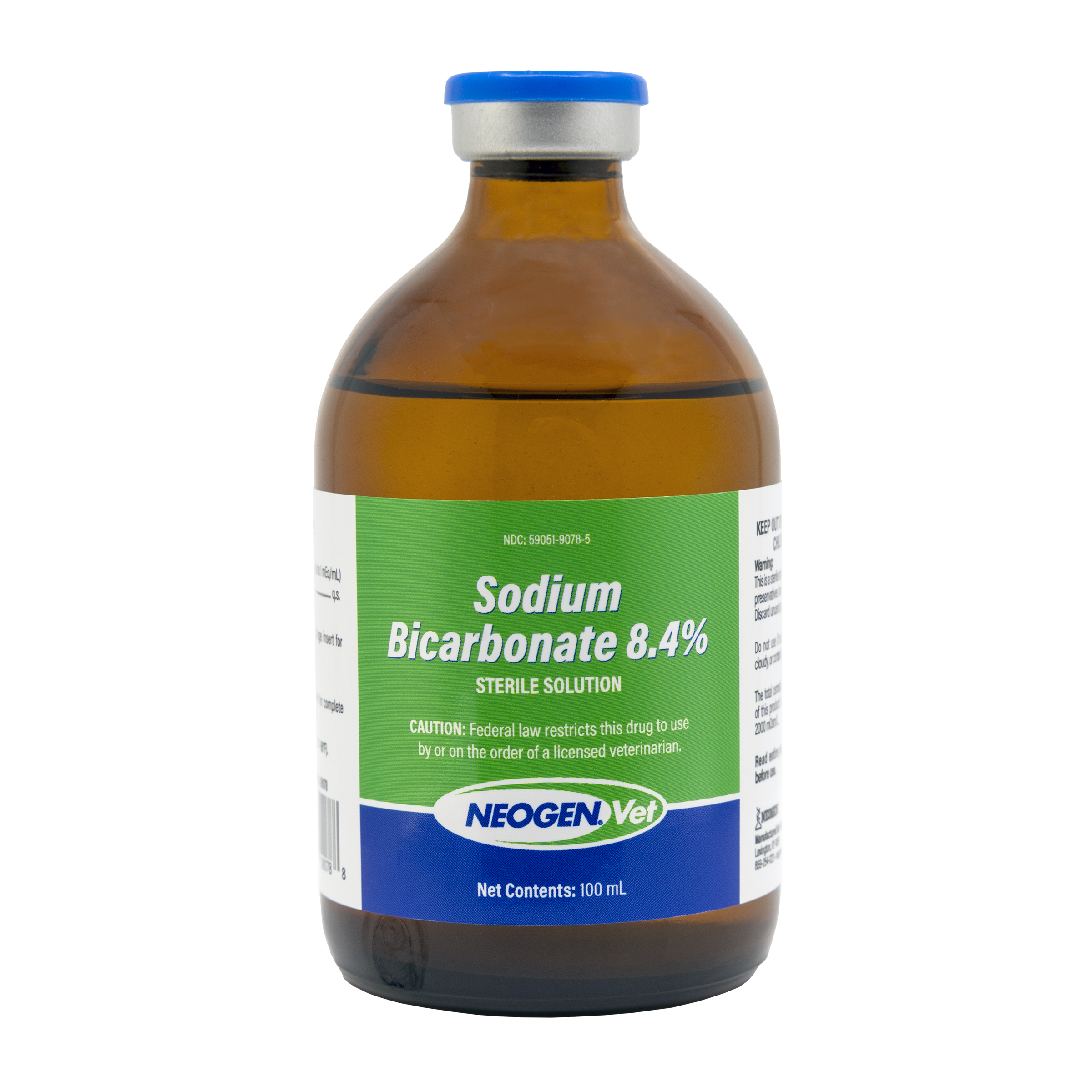
Neogen®Vet Sodium Bicarbonate 8.4% ℞
Neogen®Vet Sodium Bicarbonate 8.4%
SKU No. 09078 | Número de catálogo
- Sodium Bicarbonate is indicated in the treatment of metabolic acidosis which may be due to severe renal disease, uncontrolled diabetes, circulatory insufficiency due to shock or severe dehydration, cardiac arrest and severe primary lactic acidosis. Sodium Bicarbonate is also indicated in severe diarrhea which is often accompanied by a significant loss of bicarbonate. Sodium Bicarbonate 8.4% is indicated in the treatment of metabolic acidosis in cattle, horse, sheep, swine and dogs depending upon causative factor.
- Sterile filled
- Made in the USA
| Especificaciones | |||||||
|---|---|---|---|---|---|---|---|
| Marca | Neogen®Vet | ||||||
| Dosificación | Dosage may vary depending on the weight of the animal and must be administered by a licensed veterinarian. | ||||||
| Especies | Carne de res, Lácteos | ||||||
| Contiene | Each mL of sterile solution contains:
| ||||||
| Indicaciones | Sodium Bicarbonate is indicated in the treatment of metabolic acidosis which may be due to severe renal disease, uncontrolled diabetes, circulatory insufficiency due to shock or severe dehydration, cardiac arrest and severe primary lactic acidosis. Sodium Bicarbonate is also indicated in severe diarrhea which is often accompanied by a significant loss of bicarbonate. Sodium Bicarbonate 8.4% is indicated in the treatment of metabolic acidosis in cattle, horse, sheep, swine and dogs depending upon causative factor. | ||||||
| Aprobaciones | FDA | ||||||
| Condiciones de almacenamiento | Keep in a cool, dry, well ventilated area. Keep at temperature not exceeding 30°C. Keep containers tightly closed. Store in correctly labelled containers. Do NOT allow to freeze. Refer to label for complete indications, dosing, storage, and handling. | ||||||
| Cantidad de cajas | 12 | ||||||
| Dimensiones de la caja | 9,00 pulgada x 7,00 pulgada x 5,00 pulgada | ||||||
| Peso de la caja | 6,00 libras | ||||||
| Cantidad por paquete | 1 frasco | ||||||
| Dimensiones del empaque | 2,00 pulgada x 2,00 pulgada x 4,00 pulgada | ||||||
| Peso del paquete | 0,50 libras | ||||||
Materiales necesarios, pero no incluidos
Información adicional
Precautions: Bicarbonate therapy is directed at producing a substantial correction of low total CO2 content and blood pH, but risks of over dosage and alkalosis should be avoided. Repeated fractional doses and periodic monitoring by appropriate laboratory tests are therefore recommended to minimize the possibility of over dosage. Sodium Bicarbonate addition to parenteral solutions containing calcium should be avoided except where compatibility has been previously established. Precipitation or haze may result from sodium bicarbonate-calcium admixtures, and the resulting solution should not be administered.
Inject intravenously. Use caution in emergencies where very rapid infusion of large quantities of bicarbonate is indicated, such as cardiac arrest. Sodium bicarbonate solutions are hypertonic and may produce an undesirable rise in plasma sodium concentration during the process of correction of metabolic acidosis. During cardiac arrest, however, the risks from acidosis exceed those of hypernatremia. In cattle and horses, 200 to 300 mL of 8.4% solution may be given undiluted by rapid infusion using a needle and syringe.
Sodium Bicarbonate 8.4% solution is often added to other intravenous fluids for the less urgent forms of metabolic acidosis. The amount of bicarbonate to be given over a 4 to 8 hour period is approximately 2 to 5 mEq per kg of body weight (1-2.5 mL/body weight) depending upon the severity of the acidosis as judged by the lowering of total CO2 content, blood pH and clinical condition of the animal.
Bicarbonate therapy should always be planned in stepwise fashion since the degree of response from a given dose is not precisely predictable. Initially, an infusion of 2 to 5 mEq per kg of body weight over a period of 4 to 8 hours will produce a measurable improvement in the abnormal acid-base status of the blood. Completion of therapy is dependent upon the clinical response of the animal. If severe symptoms have abated, the frequency and size of the doses should be reduced.
Documentos
Para acceder al Certificado de Análisis (CoA), use nuestro buscador de CoA.