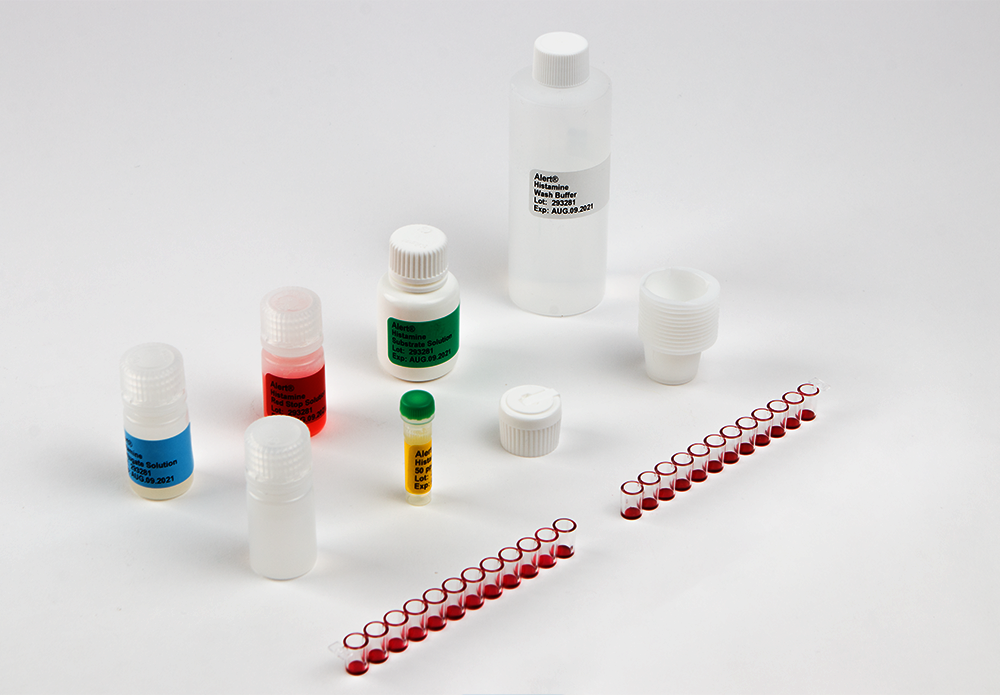
Alert® for Histamine ELISA Bulk
240 tests
SKU No. 700002754 | Catalog No. 9515B
- Simple water extraction
- 20 minutes to results
- Test one or up to five samples at one time
| Specifications | ||
|---|---|---|
| Brand | Alert® | |
| Analyte | Histamine | |
| Platform | ELISA | |
| Result Type | Qualitative | |
| Limit of Detection | 15 ppm | |
| Testing Time | 20.00 | |
| Cross Reactivity | Specific for histamine. No cross-reactivity with other biogenic amines. | |
| Quantity per Package | 240 tests | |
| Package Dimensions | 12.00 in x 10.00 in x 4.00 in | |
| Package Weight | 1.70 lb | |
Materials Provided
Materials Required But Not Provided
Documents
To access certificates, please use our technical document search page.
Insert
Procedures
Safety Data Sheet (SDS)
Technology
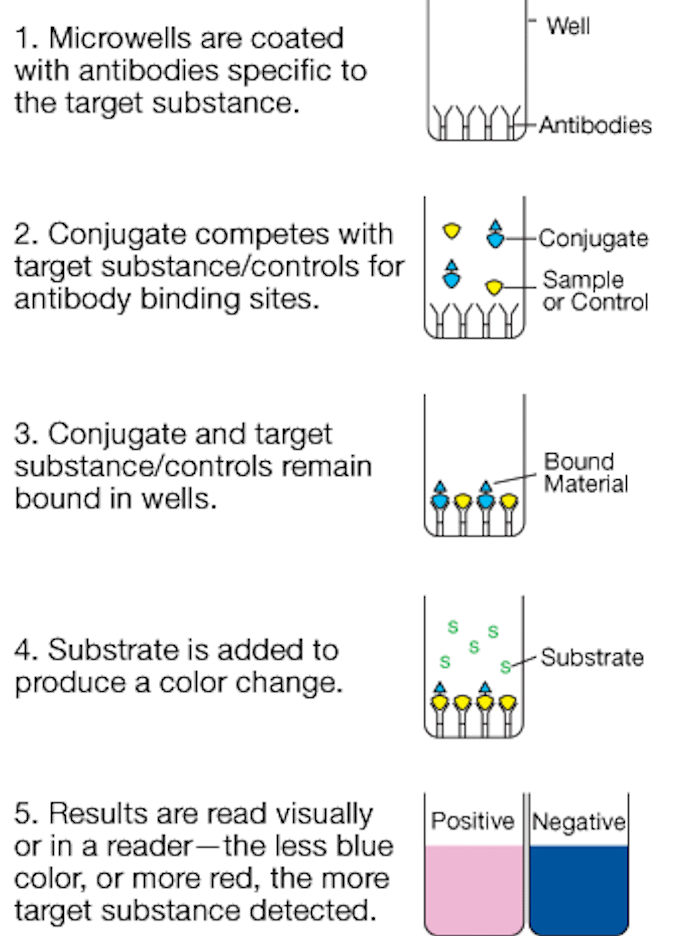
First, samples and controls are added to their respective test wells. Next, an enzyme conjugate (target substance chemically linked with an enzyme) is added. The samples/controls and conjugate are mixed and transferred to antibody wells where they compete for the antibody binding sites. The more target substance in the sample, the less conjugate that binds in the wells.
After an incubation, the wells are washed to remove all unbound materials.
A substrate, which changes color in the presence of the conjugate, is added to the wells. During an incubation, blue color develops in proportion to the amount of conjugate versus target substance in the wells. The more conjugate bound, the more blue color that develops, indicating less substance present.
Results are read visually in a screening format—the less blue color, or more red, the more target substance detected. In a quantitative format, results are obtained by measuring the wells’ color change in a microwell reader and comparing the readings against a standard curve.
Training
Our customers’ success is our shared success. Our experts are ready to train you and your team on our solutions, so you can rest easy knowing procedures are performed properly and yield accurate results. In addition, we provide certificates upon completion of training to provide you with the documentation needed for audit traceability.